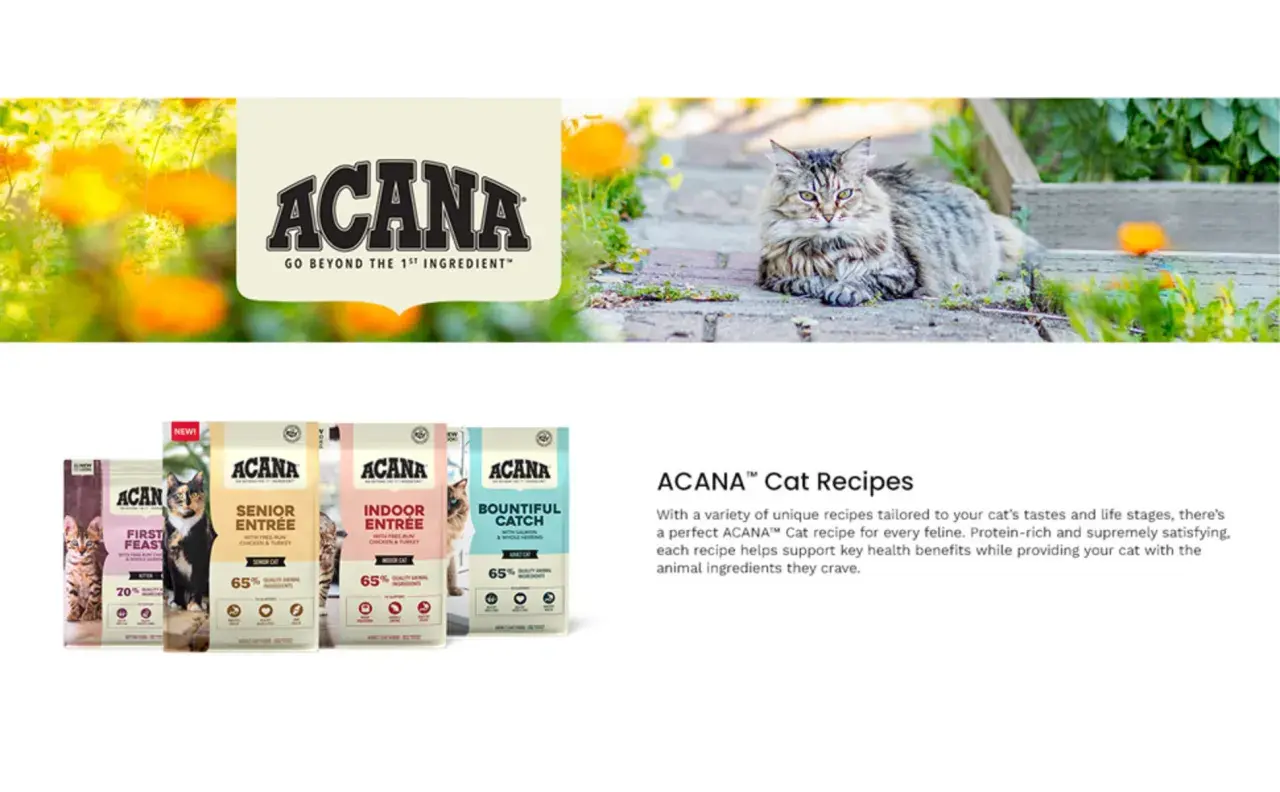
ACANA’s highest-protein indoor dry formula is built for adult cats that need a meat-forward diet without drifting into sloppy calorie control. The real question is not just how much protein it contains, but whether the balance of protein, fat, fiber, and energy actually fits an indoor cat’s daily life.
Here I break down what is in the recipe, what the label numbers mean, who it suits best, where it falls short, and how it compares with ACANA’s other indoor dry option. That is the part most cat owners need before they commit to a bag.
The essentials at a glance
- It is an adult-maintenance dry food for indoor cats, not a kitten formula.
- The current U.S. product page lists 75% animal ingredients and 38% crude protein.
- It is calorie-dense at 3755 kcal/kg, so portions matter more than marketing claims.
- The recipe is more protein-forward than ACANA’s standard indoor formula, but it also has less fiber.
- It can work well for healthy adult cats that do best on dry food, especially if you want a meat-heavy option.
- If hairballs or stool bulk are your main concern, a more fiber-forward indoor recipe may fit better.
What this recipe is meant to do
I read this formula as a high-protein indoor maintenance food rather than a special-purpose weight-loss diet. ACANA positions it for adult cats and highlights weight maintenance, digestive support, and strong palatability, which makes sense for indoor pets that are less active and sometimes too easy to overfeed.
The main attraction is simple: it is built around animal ingredients, with a recipe that leans heavily on chicken, turkey, salmon, and organ meats. On the current U.S. page, ACANA says the formula contains 75% animal ingredients and is made to meet AAFCO nutritional levels for adult maintenance. That tells me the food is meant to support a healthy adult cat’s day-to-day diet, not serve as a therapeutic product.
That distinction matters. Indoor cats often gain weight because their food is energy-dense, not because they need less protein. In practice, I care less about a dramatic protein claim and more about whether the food helps preserve lean body mass while keeping total calories under control. That is the real job here, and the label needs to back it up. To judge that properly, the ingredient panel is where the story gets clearer.
What the label says and why it matters
The easiest way to read a bag like this is to separate ingredient composition from nutrient analysis. “75% animal ingredients” describes the makeup of the recipe before processing. “38% crude protein” is the lab-measured nutrient level in the finished food. Those are related, but they are not the same thing, and that distinction helps avoid a lot of confusion.
| Label point | Current U.S. listing | Why it matters |
|---|---|---|
| Animal ingredients | 75% | Signals a meat-heavy formula and usually better palatability |
| Crude protein | 38% | High for a dry adult cat food, especially for lean body support |
| Crude fat | 15% | Adds energy and flavor, but also increases calorie density |
| Crude fiber | 3% | Lower than some indoor formulas, so it is not a hairball-first diet |
| Probiotics | 1 million CFU/lb | Supports digestion beyond simple protein content |
| Energy | 3755 kcal/kg, 428 kcal per cup | Portion control matters; this is a calorie-dense kibble |
| Taurine | 0.2% | Essential for cats and non-negotiable in a complete diet |
| Omega-3 / Omega-6 | 0.9% / 2.1% | Useful for skin, coat, and overall fatty acid balance |
The ingredient list is also worth reading closely: chicken, turkey, salmon, chicken meal, salmon meal, herring meal, eggs, fish oil, legumes, chicory root, probiotics, and freeze-dried meat inclusions. I like that this is not a vague “meat flavor” formula. It is specific, and the freeze-dried beef, goat, and lamb inclusions suggest a deliberate palatability boost rather than filler.
At the same time, the recipe is not a single-protein diet. That is fine for most healthy cats, but it is a real limitation for cats that need narrow-ingredient feeding because of intolerance or veterinary guidance. Those numbers and ingredients explain why the food works well for some cats and not for others.
Who this food suits best and who should think twice
This is the section I would use to make the actual buying decision. For the right cat, the recipe is a strong fit. For the wrong cat, it is simply an expensive way to miss the mark.
- Best fit: healthy adult indoor cats that do well on dry food and need a protein-forward, calorie-conscious maintenance option.
- Best fit: picky eaters that respond to strong animal flavor, especially when freeze-dried inclusions improve aroma.
- Best fit: cats where your priority is preserving lean mass and keeping meals satisfying without going to a prescription diet.
- Think twice: kittens, pregnant cats, and nursing cats, because this is an adult-maintenance recipe.
- Think twice: cats with chronic vomiting, diarrhea, or a history of food sensitivity that may need a simpler formula.
- Think twice: cats whose biggest issue is hairballs, because a higher-fiber indoor recipe may help more.
The caution is different if your cat has a medical diagnosis. If there is kidney disease, recurrent urinary trouble, or a digestive disorder, the decision should be made with a veterinarian. Dry food can be part of a healthy plan, but it should not be treated as a one-size-fits-all answer. Once the life-stage question is settled, the next issue is feeding it in a way that does not quietly add pounds.
How to feed it without overshooting calories
ACANA recommends using the feeding guide as a starting point, feeding twice daily, and adjusting the ration as needed to maintain optimal weight. I would keep that advice tight and practical, because this is the point where good food can still become the wrong food if portions drift upward.
My basic approach would be straightforward:
- Weigh the cat first and use the bag guide as a starting point, not a fixed rule.
- Measure the food instead of eyeballing it; 428 kcal per cup adds up fast.
- Transition over 5 to 7 days by slowly increasing the new food each day.
- Feed twice daily if your cat tends to overeat or beg between meals.
- Keep fresh water available at all times, because dry food is only 10% moisture.
- Recheck body shape every few weeks, not just body weight on a scale.
If a cat is prone to weight gain, I would not free-feed this formula. The energy density is not extreme by canned-food standards, but for dry food it is still substantial, and that makes portion creep a genuine problem. The bag can be fed dry or lightly moistened, and I would consider adding moisture if the cat drinks poorly or needs more meal satisfaction.
This is also where the product differs from ACANA’s more fiber-forward indoor recipe. If you need extra help with stool volume, hairballs, or satiety, the comparison becomes very relevant.
How it compares with ACANA Indoor Entrée
ACANA’s Indoor Entrée Recipe with Poultry & Fish is the obvious point of comparison, because it is aimed at the same general audience but solves a slightly different problem. The highest-protein indoor recipe pushes harder on meat content and protein density, while Indoor Entrée leans more toward fiber support and hairball control.
| Recipe | Protein | Fiber | Animal ingredients | Best for | Main tradeoff |
|---|---|---|---|---|---|
| Highest Protein Indoor Cat Recipe | 38% | 3% | 75% | Meat-forward indoor cats that need body-condition support | Less fiber, more calorie dense, usually pricier |
| Indoor Entrée Recipe with Poultry & Fish | 37% | 6% | 65% | Indoor cats that benefit from hairball and digestive support | Slightly less meat-heavy and less protein-forward |
The calorie numbers tell a similar story. The current U.S. page for the highest-protein indoor recipe lists 3755 kcal/kg, while Indoor Entrée lists 3630 kcal/kg. That is not a massive difference, but it is enough to matter if your cat is sedentary or already carrying extra weight.
Retail price follows the same pattern. On a recent online snapshot, the highest-protein indoor formula was listed around $29.99 for 4 lb and $53.99 for 10 lb, while Indoor Entrée was closer to $22.99 for 4 lb and $42.99 for 10 lb. In other words, the higher-protein recipe is not wildly more expensive, but it does ask you to pay a premium for the meat-forward positioning. Once you compare them side by side, the last step is checking the small details that decide whether the bag is actually a good fit for your home.
The details that decide whether this bag belongs in your cart
If I were choosing for a healthy indoor adult cat, I would ask four simple questions before buying:
- Does my cat need more protein, or does my cat need better portion control?
- Is hairball management a real issue, or is that just a marketing word I like?
- Will my cat actually eat a meat-heavy dry recipe consistently?
- Am I willing to measure meals and adjust them when body condition changes?
If the answers line up, this formula makes sense. If they do not, ACANA’s standard indoor recipe or a wetter feeding pattern may be the smarter choice. I would also pay attention to bag size, because the U.S. market currently lists 4 lb and 10 lb options, but retailer stock can vary.
My bottom line is simple: ACANA’s highest-protein indoor dry recipe is a strong option for healthy adult indoor cats that thrive on dry food and do well with a meat-forward formula. It is less persuasive if hairballs, stool bulk, or lower calories are the bigger concern. In those cases, I would look harder at the fiber-forward indoor alternative or a mixed-feeding plan that gives the cat more moisture and a little more flexibility.